If conservative leaders come into power in the 2024 election, what will become of environmental work in government?
What is Project 2025?
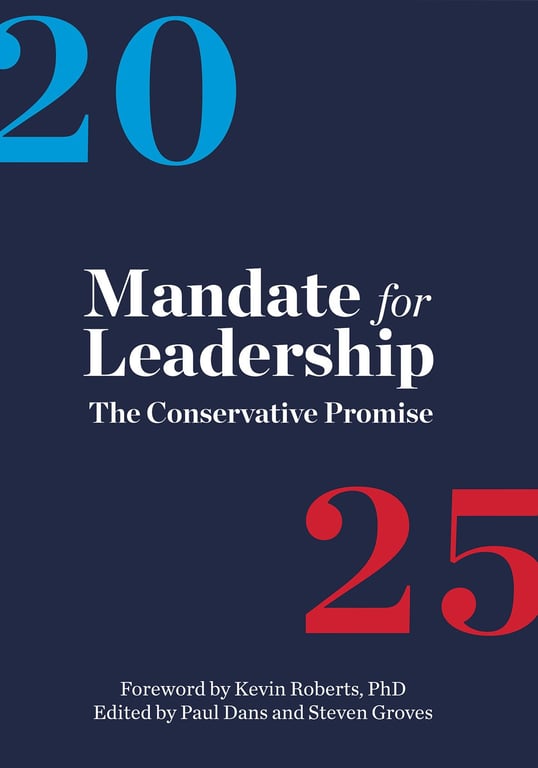
Project 2025 is a conservative policy manual officially sponsored by the Heritage Foundation, an organization fighting against the Left for a more conservative America. The manual has over 400 contributors, many of whom were formally employed under the Trump Administration, or who currently work in government.
Chapter 13 of this manual is not-so-lovingly dedicated to the Environmental Protection Agency (EPA). It’s written by Mandy Gunasekara, former chief of staff of the EPA under the Trump Administration. Far from an environmental enthusiast, Mandy is most infamous for orchestrating the United States’ withdrawal from the Paris Accord.
More ex-EPA officials can be found in the ‘Special Thanks’ section of the chapter, including names such as Clint Woods (formerly working in the Air and Radiation Office), Scott Mason IV (former director of the American Indian Environmental Office), David Harlow (formerly working in the Office of Air and Radiation), and Justin Schwab (attorney and former Deputy General Counsel).
These men all have their own histories in environmental disservice, such as Harlow being investigated for potentially going against the EPA’s Clean Air Act, or Woods working with the American Legislative Exchange Council, which has been accused of anti-environmental lobbying. Now, they all have new ideas for America’s future.
EPA Restructuring
Project 2025 has three main thesis statements in regards to the EPA:
- The EPA has too much power, and should be stripped of much of its current jurisdiction.
- The EPA is bloated, overstaffed, and largely over funded. Many of its offices are redundant.
- Climate change is not an issue the EPA should be covering, as it is not an actual threat to the American people.
These views haunt the progression of this chapter and underscore every major policy decision. Project 2025 calls for a severe crippling of the EPA as a result, preventing it from carrying out much of its intended purpose.
1) An Overreach of Power
According to Project 2025’s opening mission statement on the EPA, the organization “has been a breeding ground for expansion of the federal government’s influence and control across the economy.” (p. 418) A chief concern of the paper is that the agency has overstepped its power and is going unchecked by Congress.
Gunasekara tries to make the argument that these powers were somehow stolen from Congress and now need to be rightfully returned, but Congress is responsible for giving the EPA its regulatory power in the first place. Federal laws like the Clean Air or AIM acts were passed by Congress, allowing the EPA to carry out its role. Without this jurisdiction, the organization couldn’t function at all.
Fixing this problem, in Gunasekara’s eyes, requires a large repression of the Environmental Protection Agency. Time and time again it’s stressed that the EPA should not have any policy-making or regulatory power.
An almost laughably clear example of this is the renaming of the EPA’s current Deputy Chief of Staff for Policy to the “Deputy Chief of Staff for Regulatory Improvement.” (p. 421)
“Regulatory Improvement” is all well and good, but stripping the EPA of policy power strips it of the power to actually enforce its regulations. The ideal EPA in Project 2025’s eyes has the simple job of sitting back and making polite suggestions to those violating environmental guidelines.
2) Overfunded and Overstaffed
The EPA is currently divided into thirteen main ‘headquarters’ offices, with an additional ten regional offices that focus on more specific issues from a local perspective. Headquarters offices can also include smaller offices to further divide responsibilities. And, well, according to Gunasekara, that’s just too many.
Project 2025 calls for the elimination of the following offices:
- Office of Enforcement and Compliance Assurance
- Office of Environmental Justice and External Civil Rights
- Office of Emergency Management (Currently Office of Land and Emergency Management)
- Office of International Affairs (Currently Office of International and Tribal Affairs)
- Office of Public Engagement and Environmental Education (Currently part of the Office of the Administrator)
In some cases, it’s made clear where these resources and personnel will end up. They may even continue working to maintain the efforts of their previous offices deemed inoffensive enough to retain. For example, “ECA [Office of Enforcement and Compliance Assurance] attorneys should be moved into OGC [Office of General Counsel]. Additionally, non-attorney program staff in OECA [Office of Enforcement and Compliance Assurance] could be moved to their relevant program offices.” (p. 441)
But others are left with no such guidance. The Administrator’s Office is simply given the task of “Eliminating the Office of Public Engagement and Environmental Education as a stand-alone entity and reabsorbing substantive elements into the Office of Public Affairs.” (p. 421). There’s no guidance as to what is considered substantive, but given the fact that the whole office is on the chopping block, we have to assume it isn’t much.
This insistence on eliminating environmental education reflects Gunasekara’s views on research within the EPA.
Research and Related Science Activities
Mandy Gunasekara repeatedly states that much of the current activity within the EPA’s Office of Research and Development should be suspended and subjected to review.
The Project maintains the stance that most of the EPA’s research is unnecessary and politically fueled. It accuses the office of being “inclined to pursue political rather than purely scientific goals.” (p. 436) In the future, it’s likely many current projects would be shut down, and far less would be opened in the future.
Yet despite the project’s issues with the current perceived political lean of the EPA, its plan doesn’t involve trying to enact more bipartisan review. It just wants to inject its own agenda, saying that the “EPA should implement an approach that defaults to less restrictive regulatory outcomes.” (p. 438)
3) Climate Change
Mandy Gunasekara, former Chief of Staff of the Environmental Protection Agency, does not believe climate change is a significant issue that needs to be addressed.
In Project 2025, she refers to the issue as “the perceived threat of climate change” and goes on to say that “Mischaracterizing the state of our environment generally … is a favored tool that the Left uses to scare the American public into accepting their ineffective, liberty-crushing regulations” (p. 419).
I would ask her what the Left could possibly have to gain from encouraging these regulations. If not a better environment, then what is the point of pivoting to renewable energy that Gunasekara views as “unreliable.” Why the focus on greening pesticides? Biden’s administration was pushed to make these environmental changes by groups of voters that truly care about the planet, but Project 2025 only acknowledges these efforts as a push for greater control.
So the only option? Reduce that control, and return the EPA to where it stood at the beginning of its conception. Ignore the changes in our environment and the threats it faces while moving on as if there’s no issues. The conservative specialty.
Project 2025 sees climate change as nothing more than a political preoccupation of the democratic party, and that “Pursuit of this globally focused agenda has distracted the agency from fulfilling its core mission” (p. 418)
So what is that core mission?
The EPA was founded in 1970 under the Nixon Administration, and its primary goal was dealing with pollutants. Improving water treatment facilities, establishing national air quality standards, legislating waste dumping into the Great Lakes, and even researching ways to reduce automobile pollution were all key points for the agency.
Pollution was the name of the game, and in many ways, still is. Yet despite Project 2025 claiming it wants to return the EPA to its core mission, many of its proposals violate that core mission at the cost of Americans’ health.
The American Innovation and Manufacturing (AIM) Act, was enacted in 2020. The goal of the act is to regulate and decrease current usage of hydrofluorocarbons (HFCs). HFCs are primarily used as refrigerants, but have incredible consequences as greenhouse gases, estimated to be hundreds or thousands of times more powerful than CO2.
But, Project 2025 has other plans, saying it needs to “Repeal Biden Administration implementing regulations for the AIM Act that are unnecessarily stringent and costly.” (p. 425). This standard completely ignores the very real public health risks of HFCs, which are enough of an issue that global efforts have been mounted to decrease their usage.
Project 2025 puts forth an EPA that doesn’t care about climate change, and in doing so can’t care about its core mission at all: one of protecting American’s health.
Will this Actually Come to Pass?
As Project 2025 has become more well-known, Trump has tried to distance himself from the statements of the conservative think tank, albeit in some confusing ways. He both claims not to have read the document, while also stating quite clearly that parts of it are “absolutely ridiculous and abysmal.” And that he wishes them luck?
Regardless of his stance on Project 2025 itself, a Trump presidency will not mean good things for the EPA. During his last term, his administration reversed over 100 environmental rules, detailed fully here.
Trump would get to make another round of EPA appointments, outing current administrators of the agency with his own selections. This means people like Mandy Gunasekara and her special thanks squad would be back in power.
Outside of just the presidency, every Congress seat up for election will have the power to affect not only the Environmental Protection Agency, but environmental rulings across the nation.
The reality is that Project 2025 is an enormous document with many lofty goals, and the writers of these goals likely know that they cannot expect all of them to pass. But at the same time, the EPA is an organization already facing challenges in the work they do.
Even with democratic leaders in power, environmentalism is a battle, and we need to make sure we pick our opponents wisely. I don’t want to have to waste my time fighting against Project 2025’s future when I could use it fighting for a greener world.
 Made with Bullet